Our Hosting Review Methodology
Last updated
This is the page every comparison and review on elitewphost.com links to. If a number on this site can’t be traced back to something below, treat it as suspect and email us. We run this site in two phases, what we do today is the research-synthesis phase; what we are commissioning is the live-benchmark phase. Both are documented here.
Where we are right now (Phase 1)
Status, May 2026: we do not yet operate a live benchmark rig. That sentence is also at the top of every cornerstone article on this site and we repeat it here so a reader who skims past the disclaimer there cannot miss it here.
Until the rig is online, every ranking on elitewphost.com is the output of three things, in this order:
- Plan-spec analysis, we read each host’s published plan documentation (PHP worker counts, RAM, CPU, edge-cache rules, included add-ons, support response SLAs, refund terms) and cross-check the marketing page against the docs page and against the host’s status-page history. We link the documentation inline in every comparison so a reader can verify each claim themselves.
- Cited third-party tests, we read existing benchmarks from sources that disclose their methodology (k6/loader.io tests published by other reviewers, WP Hive’s standardised tests, Google CrUX field data where a host’s reference customers expose it, Cloudflare Radar where edge data is published). We cite the source inline; we do not summarise without a link.
- Operational experience, Mark has run real WooCommerce stores on five of the eight hosts we currently cover (Kinsta, WP Engine, Cloudways, SiteGround, Hostinger), in production, between 2016 and today. Where a claim depends on operational experience rather than published data, we mark it as such (look for “in our experience”, that is the trigger phrase).
What this means in practice: a ranking on this site is currently a defensible synthesis of public data and lived experience. It is not yet a measurement. A ranking can be wrong; a measurement, when we have it, will be reproducible. We will replace synthesised claims with measured ones host-by-host as Phase 2 comes online.
What we are commissioning (Phase 2)
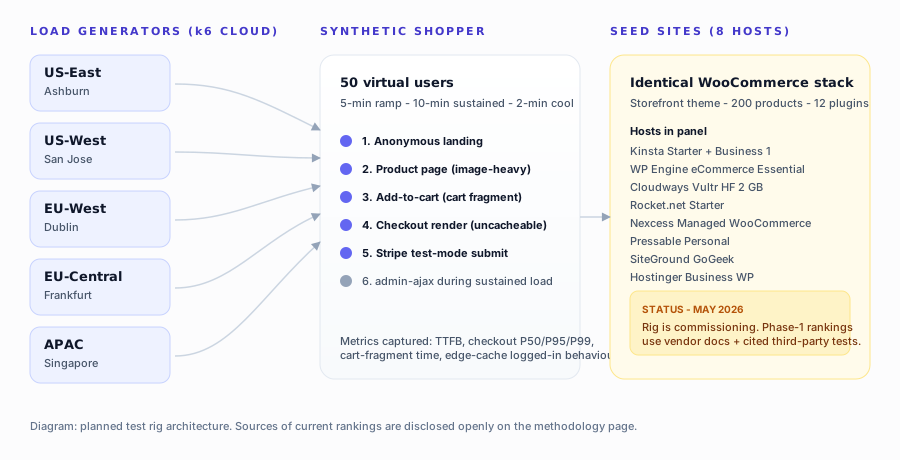
Phase 2 is a multi-region k6 benchmark rig that puts the same WooCommerce stack on every host in our panel and hits it with the same synthetic shopper. The architecture is below. It is not running yet. The diagram describes the target rig, not the current state.
The pieces:
- Load generator, k6 Cloud, hitting each origin from US-East (Ashburn), US-West (San Jose), EU-West (Dublin), EU-Central (Frankfurt) and APAC (Singapore).
- Synthetic shopper, anonymous landing → product page → add-to-cart → checkout page render → simulated payment submission (Stripe test mode). 50 virtual users, 5-minute ramp, 10-minute sustained, 2-minute cooldown.
- Identical seed site on every host, WooCommerce Storefront theme, 200 products with images, 12 plugins matching what a real $100k to $500k/year store typically runs (WooCommerce, WooCommerce Subscriptions test build, Yoast, WP Rocket where allowed by host, etc.). The seed-site GitHub repo will be public once the rig stabilises.
- Hosts in the panel, Kinsta Starter + Business 1, WP Engine eCommerce Essential, Cloudways Vultr HF 2 GB, Rocket.net Starter, Nexcess Managed WooCommerce Starter, Pressable Personal, SiteGround GoGeek, Hostinger Business WP. Plans chosen to match the entry tier a real store would buy.
Rig commissioning roadmap (public):
| Milestone | Status | ETA |
|---|---|---|
| Seed-site repo public on GitHub | Not started | Jun 2026 |
| Single-host pilot run (Kinsta Starter, EU-West only) | Not started | Jul 2026 |
| Full 8-host single-region pass | Not started | Aug 2026 |
| Full 8-host x 5-region pass | Not started | Sep 2026 |
| Quarterly cadence stable | Not started | Q4 2026 |
These dates move when reality moves. We will update this table in public; we will not silently revise targets.
Metrics we plan to measure
When Phase 2 is live, every host gets scored on:
| Metric | Why it matters for WooCommerce |
|---|---|
| TTFB (Time to First Byte) | Floor on every other speed metric; cached and uncached. |
| Checkout latency | Uncacheable, PHP-worker-bound. The number that decides cart abandonment. |
| Cart-fragment request time | ?wc-ajax=get_refreshed_fragments runs on every page with a cart widget. Sneaky tax on TTFB everywhere. |
| admin-ajax response under sustained load | Backend pain, slow admin = slow order fulfilment during peak. |
| PHP worker behaviour under sustained load | When workers queue, customers wait. We trigger queueing on purpose. |
| Edge cache logged-in behaviour | Does the host’s edge cache correctly skip cached HTML for logged-in or cart-bearing sessions? Generic page caches break this. |
| Sustained 99th-percentile checkout latency | The customer who waits 8 seconds is the one who abandons. P95 is too kind. |
We do not chase Lighthouse scores. Lighthouse measures one anonymous pageview; a store cares about the 47th concurrent checkout.
How rankings are scored
Each host is scored 0 to 10 on each of the metrics above, weighted as: checkout latency 25%, P99 checkout under load 20%, TTFB (multi-region average) 15%, PHP worker scaling 15%, edge cache logged-in correctness 10%, cart-fragment + admin-ajax 10%, refund/trial generosity 5%. Weights are written down here so you can disagree with them. If you reweight and reach a different ranking, that is a legitimate read of the same data.
In Phase 1 (today), the same weights apply but each score is sourced from documentation / third-party / operational experience rather than measurement and the score is given a confidence band (low / medium / high) noted in the per-host writeup.
We do not include commission rate, partner-program perks, or refer-a-friend bonuses in the scoring. See “Conflict of interest” below.
Conflict of interest, our rules
- Affiliate commissions do not influence ranking. The rule is written down and we will publicly note it when a host pays better commission than a higher-ranked competitor we link below it. (Example: WP Engine pays $200+ flat vs Kinsta’s 10% recurring; if Kinsta wins a comparison, the WP Engine link still sits where the data puts it.)
- We do not accept paid placement, sponsored slots in comparison tables, “featured host” badges, or any consideration in exchange for ranking.
- We disclose every program we are evaluating on the affiliate disclosure page, including the ones that have not approved us yet.
- The editorial team is small and named. Decisions live with Mark Halloway. There is no anonymous “team” to hide a bad call behind.
Corrections and update cadence
- Cornerstone articles (the four pillars): full re-test quarterly. Price/feature tables refreshed monthly. In Phase 1, “re-test” means re-reading vendor docs + checking for plan changes; in Phase 2 it means re-running the rig.
- Per-host reviews: updated within 2 weeks of any plan, price, or infra change.
- Cluster articles: 6-month refresh sweep.
- Every correction is dated in the article body. We do not silently rewrite history.
Disputing our methodology
If you operate a host we cover and you think our test setup is unfair, or you’re a reader who spots a flaw, email hello@elitewphost.com with the subject line “methodology dispute.” We will respond within 7 days, publish the exchange on this page if you prefer, and either update the methodology or re-run the test when the critique holds up.